





Reduce approval fatigue without reducing control: consent vs approval

In many organizations, “approval” has quietly become the default language of decision-making. Documents are sent for approval, tasks are routed for approval, and even low-risk changes are expected to pass through layers of formal sign-off. At first glance, this approach feels responsible - after all, more approvals should mean more control.
But over time, a different pattern emerges.
When everything requires approval, people stop treating approvals as meaningful decisions. Stakeholders click through requests quickly just to keep work moving. Important items get lost among routine ones. What was meant to ensure quality and accountability slowly turns into a bottleneck, and, paradoxically, a risk. This is what approval fatigue looks like in practice: not just slower workflows, but weakened governance.
When approval loses its meaning
The issue is not that approvals are bad. On the contrary, they are essential in the right contexts. Legal agreements, financial commitments, compliance-sensitive processes - these absolutely require careful review and explicit acceptance. The problem begins when the same level of rigor is applied everywhere. A minor documentation update is treated the same way as a contract. A low-impact Jira task waits for multiple approvals from people who may not need to be deeply involved. Managers are asked to formally approve changes they would otherwise just glance at.
Over time, this creates a system where approvals are no longer signals of responsibility - they are simply steps in a process. And when that happens, governance loses its core meaning.
A more nuanced approach: consent vs approval
One way to restore that meaning is to introduce a clearer distinction between two concepts that are often treated as identical: consent and approval.
Consent is about permission. It creates space for stakeholders to raise concerns, but it does not demand active validation from everyone involved. Approval, on the other hand, is a stronger statement - it means that someone has reviewed something and accepts it as satisfactory. This difference may seem subtle, but it has a profound impact on how workflows function.
Imagine a scenario where a document is shared with a group of stakeholders. Not all of them need to formally approve it, but they should have the opportunity to flag issues. In a consent-based model, the expectation is clear: review if relevant, speak up if something is wrong, otherwise allow the process to continue. Silence is not negligence. It is an acceptable outcome. Contrast this with a strict approval model, where every participant is expected to actively confirm their agreement. In such cases, the process only moves forward when each required person has taken explicit responsibility for the decision. Both approaches are valuable. The key is knowing when to use each.
Restoring balance in your workflows
By distinguishing between consent and approval, organizations can begin to rebalance their governance models. Lower-risk activities can move faster because they rely on visibility rather than formal sign-off. People are informed, involved, and empowered to intervene if necessary, but they are not forced into unnecessary decision-making. At the same time, high-risk or high-impact actions retain the rigor they deserve, with clear accountability and deliberate approval. The result is not less control, but more focused control.
Instead of spreading attention thinly across every task, stakeholders can concentrate on the decisions that truly require their expertise. Approvals regain their weight, and when someone approves something, it actually means something.
How to support this approach in real life
In theory, separating consent from approval is straightforward. In practice, it often runs into a limitation: many tools treat all decisions as approvals, without offering a lighter alternative. This is where workflow flexibility becomes critical.
The Approval Path app for Jira and Approval Path for Confluence are apps designed with this reality in mind. While it technically operates on a unified mechanism, it allows teams to model both strict approval processes and lighter, consent-style interactions within the same framework. This flexibility makes it possible to reflect real-world decision-making more accurately. Teams can design flows where stakeholders are invited to review and respond, rather than required to formally approve everything. They can also introduce the option to abstain - an important nuance that acknowledges that not every participant has a strong opinion or the necessary context. Abstention plays a subtle but powerful role. It allows individuals to remain part of the process without becoming blockers. If others agree, abstention effectively supports that agreement. If others raise concerns, it aligns with the need to revisit the decision. In this way, participation becomes more expressive without becoming more complicated.
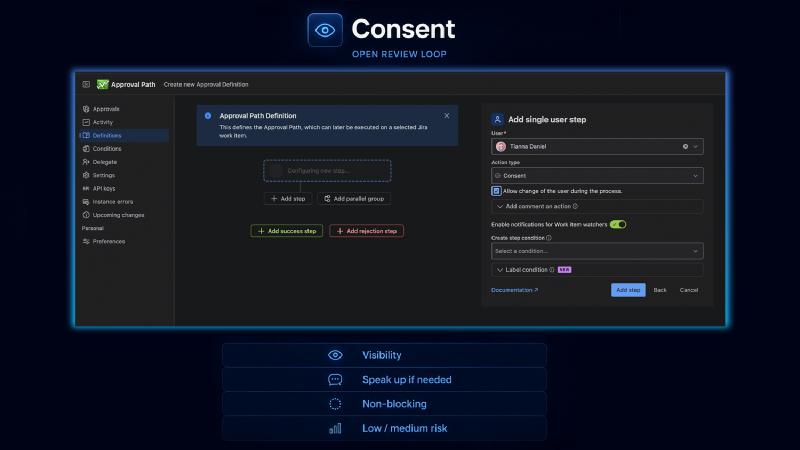
Interestingly, from a purely technical perspective, there may be no strict difference between consent and approval in the system itself. The distinction is semantic rather than mechanical. And yet, that semantic layer is exactly what enables better process design. By consciously deciding when a step represents consent and when it represents approval, organizations can reshape how people interact with workflows. Expectations become clearer, responsibilities more precise, and outcomes more meaningful. The system doesn’t need to change fundamentally - only the way it is used. More meaningful decision-making
Reducing approval fatigue is not about removing structure or weakening oversight. It is about making governance intentional again. When approvals are reserved for the moments that truly require them, they regain their importance. When consent is used to provide visibility without friction, workflows become more fluid and responsive. Together, these approaches create a system that is both efficient and accountable. In the end, the goal is not fewer decisions - it is better ones. And that starts with recognizing that not every decision needs to be an approval.