





External Share vs Confluence Guests vs Public Links: How to Share Confluence Content Externally
External collaboration in Confluence is no longer a single-choice decision. Today, teams can invite external people as Confluence Guests, share individual content with Public Links, or use External Share for Confluence to create secure, controlled links for clients, vendors, partners, auditors, and stakeholders. All three options can help you share Confluence content outside your organization. But they solve different problems, so the right choice depends on your goals. The short version:

Give your marketing team superpowers: collaborate with partners where work actually happens - on Confluence
Marketing teams today operate at a rapid pace. Campaigns move quickly, content is constantly evolving, and collaboration is at the heart of everything. For many teams, Confluence has become that central hub - a place where ideas are shaped, plans are documented, and execution comes to life. But there’s a moment where even the most organized workflows begin to break down: the moment external partners (or even teams) enter the process.
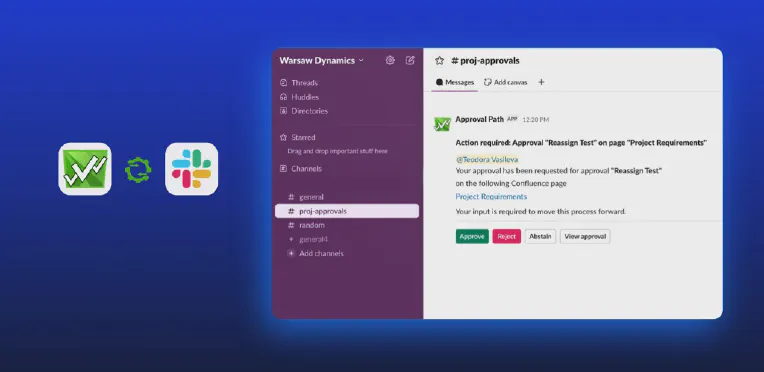
Approvals That Follow the Work, Not the Other Way Around: Bringing Approval Path to Slack
Approval processes often fail not because the workflow is wrong, but because the decision gets lost between tools, tabs, inboxes, and busy schedules. They are rarely the “main task” someone is doing, and they sit between product releases, document reviews, budget confirmations, access decisions, content publishing, or process checkpoints. The problem is not always the approval itself as a separate, time-consuming action, but rather that the request often lives elsewhere.
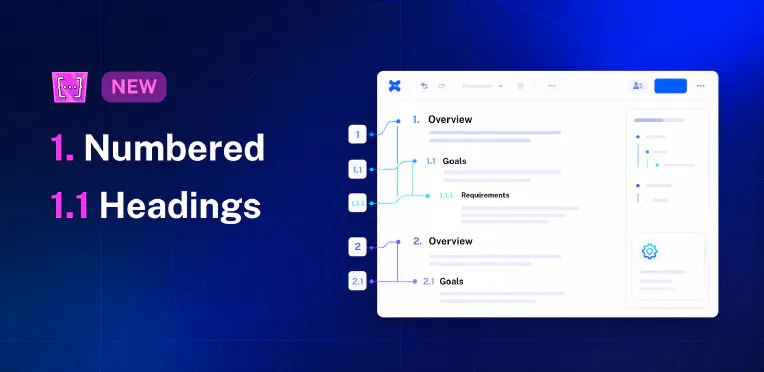
Fix The Numbering Problem Confluence Never Solved with Macro Pack's Latest Feature
Confluence has helped teams create structured documentation for more than twenty years, yet one deceptively simple feature has remained difficult to solve properly: numbered headings. It is not a new request. “Numbered Headings” has been one of the long-standing Confluence feature requests for years, especially for teams working with specifications, legal documents, procedures, audits, and other structured content where section numbers are not optional. And there is a reason the problem is harder than it looks.
Write better and streamline your technical documentation with Macro Pack
Confluence is a powerful platform, but when it comes to technical documentation, its native formatting often feels restrictive. Architecture diagrams, API specifications, structured data, and technical markup quickly exceed what basic macros can handle. As a result, teams rely on screenshots, external links, or multiple apps that are difficult to maintain and keep in sync. If your documentation struggles to keep up with your needs, the problem might be your tooling.

9 Essential Actions for Teams in Confluence
Confluence has become the backbone of collaboration for thousands of teams worldwide. Yet, according to Atlassian’s State of Teams 2025 report , workers still spend nearly 25% of their time just searching for information. And as Atlassian’s AI Rovo or other AI tools reshape how we work, structured and accessible documentation has never been more essential. Here are nine research and data-backed steps every team should take before 2026 to get the most out of Confluence.

Easy Insights, Anywhere: eazyBI with External Share for Confluence
If you use eazyBI for Jira and Confluence, you already know how powerful it can be. eazyBI is a general-purpose Business Intelligence (BI), analytics, and reporting tool supporting many data sources — including tightly integrated dedicated apps for Atlassian Jira and Confluence. It enables teams to build rich reports, dashboards, visualizations, and custom analyses directly inside the Atlassian ecosystem. Why External Sharing Can Still Be Tricky While eazyBI is not a real-time analysis tool, this is an intentional design choice that ensures performance and reliability across large datasets.

When “Peak Billing” Comes Knocking: How to Manage Atlassian’s New Pricing with Smarter Sharing
If you are not living under a stone, you must have heard about Atlassian’s new pricing model. This October, they introduced the “maximum quantity billing” (MQB) - a major shift in how customers are billed. This change is intended to provide more predictable costs and simpler tracking for budgeting and planning. But, at the same time, customers will need to manage user licenses carefully to optimize costs, especially if user counts fluctuate frequently within a month.

Build, Brand, and Publish a Confluence Knowledge Base: Comparing External Share and Scroll Viewport
When you need to share Confluence content beyond your internal team, the right app can transform how you work. A particular case is when your Confluence content needs to double as a public knowledge base - the right add-on determines how polished, secure, and easy to maintain the final site can be. In this article, we want to introduce two of the most popular solutions: Warsaw Dynamics’ External Share for Confluence and K15t’s Scroll Viewport for Confluence .

Macro Pack: Now We're Moving to a Paid Model
Macro Pack (PlantUML, Swagger, Open API, Markdown, HTML, Latex, AsciiDoc) is a Confluence app that extends the platform with a wide range of powerful macros. It supports a wide variety of input sources such as URLs, attachments, GitLab, GitHub, Bitbucket, and text, and works seamlessly with formats like HTML, JSON, CSV, AsciiDoc, Markdown, Mermaid, OpenAPI/Swagger, PlantUML, Draw.io, and LaTeX. Until now, Macro Pack has been completely free. Starting October 2025, we’ll be transitioning to a paid model.